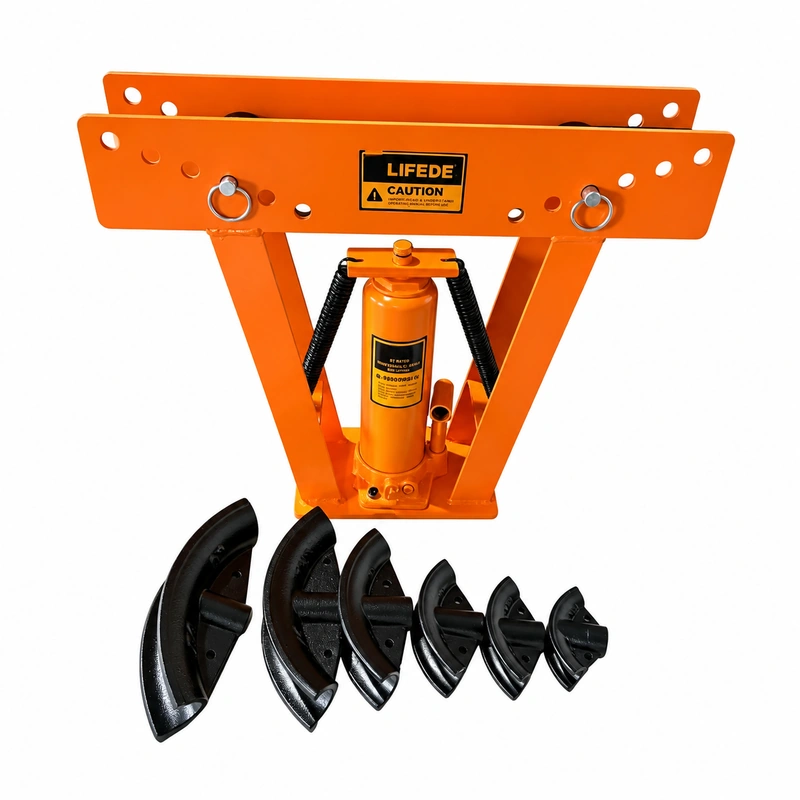
In metal fabrication, pipeline installation, and equipment maintenance, achieving consistent pipe bends without damaging the material is essential for professional results. LIFEDE offers the 12 Ton Manual Hydraulic Pipe Bender Tool with 6 Dies, a practical solution designed to deliver controlled hydraulic bending force, flexible pipe-size compatibility, and convenient operation without electricity. With its durable steel construction and six interchangeable dies, this equipment provides workshops, contractors, and industrial tool distributors with a versatile solution for various pipe-forming requirements.
A 12-ton manual hydraulic pipe bender is a valuable tool for professionals who need reliable pipe-forming performance in workshops and on-site working environments. This article explores how a hydraulic bending mechanism works, why six interchangeable dies improve flexibility, which industries benefit from this equipment, and what buyers should consider before selecting a pipe bender. It also introduces the LIFEDE DE0927 model, including its construction, specifications, operating procedure, and maintenance recommendations.
1. Understanding the 12 Ton Manual Hydraulic Pipe Bender
2. Why Are Six Interchangeable Dies Important?
3. How Does 12-Ton Hydraulic Force Improve Bending?
4. Advantages of Manual Hydraulic Operation
5. Durable Steel Construction and Product Specifications
6. Main Applications Across Different Industries
7. How to Operate a Manual Hydraulic Pipe Bender
8. What Should Buyers Consider Before Purchasing?
9. Maintenance Tips for Reliable Performance
10. Frequently Asked Questions
11. Conclusion: Choosing the Right Hydraulic Pipe Bending Solution
A hydraulic pipe bender is designed to reshape metal pipes into specific angles and configurations using controlled hydraulic pressure. Compared with basic mechanical bending tools, hydraulic equipment generates greater force with less physical effort from the operator.
The 12 Ton Manual Hydraulic Pipe Bender Tool with 6 Dies from LIFEDE is designed for professional maintenance, construction, and metal fabrication applications. Its hydraulic mechanism delivers a rated bending force of 12 tons, while its interchangeable die system allows operators to select different bending configurations according to their pipe dimensions.
One of its major advantages is its combination of power and portability. Instead of depending on a large stationary bending machine, users can transport this equipment between workshops and job sites.
Key product characteristics include:
Different pipeline projects involve different pipe dimensions, materials, and bending requirements. A tool designed for only one pipe size may limit productivity and require additional equipment purchases.
The six-die configuration of the LIFEDE hydraulic pipe bender offers greater flexibility for users who regularly handle different pipe specifications.
Interchangeable dies allow operators to select a suitable bending form according to the pipe dimensions and intended application. This helps make the equipment more adaptable to maintenance workshops, fabrication facilities, and installation projects.
Instead of purchasing several dedicated bending tools, businesses can use one machine with multiple dies to address different bending requirements. This can simplify equipment management and reduce unnecessary investment.
Using a properly matched die helps distribute bending pressure more appropriately and reduces the risk of excessive flattening or uneven deformation. Correct die selection is particularly important when working with thin-wall pipes or materials that are sensitive to bending stress.
However, the six dies should not be assumed to cover every possible pipe diameter. Buyers should confirm the actual die dimensions and compatible pipe specifications with the supplier before ordering.
Hydraulic force is one of the most important factors affecting the performance of a manual pipe bender. The 12-ton capacity of the LIFEDE model DE0927 provides substantial mechanical force for forming suitable metal pipes.
During operation, the hydraulic pump converts manual handle movement into hydraulic pressure. This pressure drives the working ram forward, applying force to the pipe through the selected bending die.
Gradually increasing hydraulic pressure gives operators better control over the bending process. Rather than applying sudden mechanical force, users can monitor the pipe's shape and stop when the required bending angle is reached.
Pipe flattening, wrinkling, and surface damage are common concerns in bending operations. Appropriate die selection, correct pipe positioning, and gradual pressure application help minimize these problems.
For maintenance teams and fabrication workshops, controlled hydraulic bending can improve the repeatability of routine operations. Nevertheless, actual bending results depend on pipe diameter, wall thickness, material properties, and the required bending radius.
Not every working environment has access to electrical equipment or large industrial machinery. A manual hydraulic pipe bender provides an alternative for users who need a portable and relatively simple bending solution.
The LIFEDE 12-ton model operates through a manually controlled hydraulic system, eliminating the need for an external electrical power supply.
Its main advantages include:
For small and medium-scale bending requirements, manual hydraulic equipment can provide a practical balance between working capacity, operating convenience, and equipment investment.
Structural stability is essential for hydraulic equipment because the frame must withstand substantial forces during bending. The LIFEDE DE0927 hydraulic pipe bender features a steel structure designed to provide reliable support during regular operation.
Its welded construction helps maintain structural stability, while the compact overall design makes transportation and equipment storage more convenient.
| Specification | Product Details |
|---|---|
| Product Name | 12 Ton Manual Hydraulic Pipe Bender Tool with 6 Dies |
| Model | DE0927 |
| Hydraulic Capacity | 12 Tons |
| Die Configuration | 6 Interchangeable Dies |
| Material | Steel |
| Net Weight | 30.5 kg |
| Gross Weight | 31.5 kg |
| Product Dimensions | 650 × 580 × 170 mm |
| Available Colors | Red / Blue / Custom |
| Packaging | Carton |
| Operation | Manual Hydraulic |
These specifications make the DE0927 a practical option for professional users who need a portable hydraulic bending tool with a substantial force rating. For detailed compatibility information, buyers should request the die-size chart and applicable pipe specifications before confirming an order.
A versatile manual hydraulic pipe bender can support a wide range of industrial and commercial maintenance tasks. Its combination of hydraulic force and interchangeable dies makes it useful in several working environments.
During pipeline installation, technicians may need to adjust pipe directions to accommodate equipment layouts, connection positions, or restricted installation spaces. A manual hydraulic bender provides a convenient solution for suitable pipe-forming tasks.
Construction projects involving metal piping systems often require customized pipe configurations. Portable hydraulic bending equipment helps contractors complete certain adjustments directly at the project site.
Fabrication workshops can use hydraulic pipe benders for custom metal components, equipment repairs, and general pipe-forming operations. The six-die configuration helps accommodate different working requirements.
Maintenance professionals may encounter pipe adjustments during machinery servicing and vehicle component repairs. A manual hydraulic tool offers a practical option when the required pipe dimensions and material are compatible with the equipment.
Farm machinery frequently operates in demanding environments where damaged or modified piping components may require repair. Portable bending equipment can help maintenance technicians handle suitable pipe adjustments without transporting equipment to a large fabrication facility.
Proper operating procedures are important for achieving accurate bending results and maintaining equipment safety. Before beginning, inspect the machine and verify that the selected die matches the pipe specifications.
Choose one of the six dies according to the pipe dimensions and bending requirements. Make sure the die is correctly installed and securely positioned.
Place the pipe in the bending area and align the intended bending point with the center of the die. Incorrect positioning may cause uneven pressure or unwanted deformation.
Close the hydraulic release valve and operate the pump handle gradually. Increase pressure in a controlled manner while monitoring the bending process.
Once the desired bending operation is complete, slowly open the release valve to relieve hydraulic pressure and allow the ram to return.
Carefully remove the finished pipe and inspect its bending angle, surface condition, and cross-sectional shape. Verify that the finished component meets the project requirements.
Safety reminder: Always follow the manufacturer's operating instructions. Keep hands clear of moving components, avoid exceeding the equipment's rated capacity, and never attempt to adjust the pipe while it is under hydraulic pressure.
Selecting a hydraulic pipe bender involves more than comparing hydraulic capacity. Buyers should evaluate the equipment against their actual application requirements.
Consider the following factors before making a purchasing decision:
For importers and distributors, it is also worth discussing customized colors, packaging, and OEM cooperation with the manufacturer. These details can help align the product with specific market requirements.
Regular maintenance helps preserve hydraulic performance and extends the service life of workshop equipment. Although manual hydraulic pipe benders have relatively straightforward operating mechanisms, their hydraulic and structural components still require proper attention.
Recommended maintenance practices include:
The LIFEDE hydraulic pipe bender is supplied with hydraulic oil already filled. When additional oil is required after extended use, follow the manufacturer's recommendations. Engine oil and gear oil should not be used as substitutes for the specified hydraulic oil.
It is used to bend suitable metal pipes for pipeline installation, mechanical maintenance, construction, and fabrication projects. Its 12-ton hydraulic capacity provides controlled bending force, while the six interchangeable dies offer flexibility for different pipe dimensions.
Six dies allow operators to select different bending configurations according to their pipe dimensions. This improves equipment versatility and can reduce the need to purchase multiple dedicated bending tools. Buyers should confirm the actual dimensions of the included dies before ordering.
No. The LIFEDE DE0927 uses a manual hydraulic operating system and does not require an external electrical power supply. This makes it suitable for outdoor maintenance, construction sites, and workshops where electricity is not readily available.
The net weight is 30.5 kg, while the gross weight is 31.5 kg. Its listed dimensions are 650 × 580 × 170 mm, providing a relatively compact configuration for transportation and storage.
Choose the correct die, position the pipe accurately, and apply hydraulic pressure gradually. The pipe material, wall thickness, and bending radius should also be appropriate for the intended operation. Testing a sample piece before production is recommended when working with unfamiliar materials.
Yes. The product is supplied with hydraulic oil already filled. For future replenishment, users should follow the manufacturer's hydraulic oil specifications and maintenance recommendations rather than substituting engine oil or gear oil.
Yes. The DE0927 is available in red, blue, and customized colors. LIFEDE also supports OEM cooperation and customized packaging solutions according to distributor and market requirements. Buyers can discuss their specific purchasing needs directly with the sales team.
It is primarily designed for workshop operations, construction, installation, and maintenance applications. For high-volume automated production, buyers should evaluate whether a manual hydraulic tool can meet their required production rate and dimensional tolerances or consider dedicated industrial bending machinery.
Choosing the right pipe bending equipment can improve workshop flexibility, simplify maintenance operations, and help achieve more consistent metal-forming results. The 12 Ton Manual Hydraulic Pipe Bender Tool with 6 Dies combines substantial hydraulic force, six interchangeable dies, a durable steel structure, and electricity-free operation in one practical piece of equipment.
With its DE0927 model, LIFEDE provides a solution for contractors, maintenance professionals, fabrication workshops, and industrial tool distributors seeking versatile manual hydraulic bending equipment. Its compact dimensions, manageable weight, and customization options also make it worth considering for professional tool sourcing and wholesale purchasing.
If you are looking for a reliable hydraulic pipe bender manufacturer and want to learn more about product specifications, die compatibility, OEM customization, or bulk purchasing options, LIFEDE is ready to assist. Visit the 12 Ton Manual Hydraulic Pipe Bender Tool with 6 Dies product page or contact us today to discuss your requirements and find the right hydraulic pipe bending solution for your business.